


Foot fungus is an extremely unpleasant and very common infectious disease.According to statistics, one in five people in the world shows symptoms of a fungal infection at least once in their life.The widespread spread of the fungus is prevented only by the body's defenses, as well as the achievements of modern medicine.Ringworm can be cured;it is only important to detect the disease in time and start appropriate therapy.
Causes of the fungus
Fungal skin diseases (mycoses) most often occur against the background of reduced immunity.The human body, unable to protect itself from dangerous infectious agents, is susceptible to a wide variety of diseases.In this case, not only the internal organs suffer.
Changes in local immunity lead to increased skin permeability.The skin can no longer fulfill its protective function and pathogens enter its interior, causing inflammation to develop.The development of foot fungus is an unpleasant phenomenon that can significantly ruin anyone's life.
They provoke fungal diseases and any damage to the skin.Abrasions, scratches and cuts, not to mention open wounds - these are all entry points for any infection.
And if a healthy person can still cope with the fungus, then with reduced immunity, any wound can cause illness.The fungus penetrates the skin, multiplies and causes significant discomfort by its mere existence.
In advanced cases, toe fungus can spread to the skin of the feet and legs, causing serious illness.
Factors that provoke the development of mycoses:
- vascular diseases of the legs;
- metabolic diseases (diabetes mellitus);
- excess body weight;
- wear tight shoes;
- toe injuries;
- damage to the skin around the nails during a pedicure.
Foot fungus is a common problem for people who frequent public baths and saunas.A warm, humid room is an ideal environment for fungi to multiply and spread across human skin.
You can get an infection from the pool as well as from the beach.Anywhere you have to walk barefoot or wear someone else's (public) shoes, the risk of yeast infection increases several times.
It is noticed that fungal diseases of the skin of the feet and nails are more common in people with excess body weight.Mycoses also occur in the context of diabetes mellitus and other metabolic diseases.
It happens that with these pathologies, blood circulation in the lower extremities is impaired.Any small scratch in diabetes takes a long time to heal and is an ideal entry point for a fungal infection.
Fungus between toes is also a common companion for the elderly due to age-related decline in immunity.
Symptoms of a fungal infection
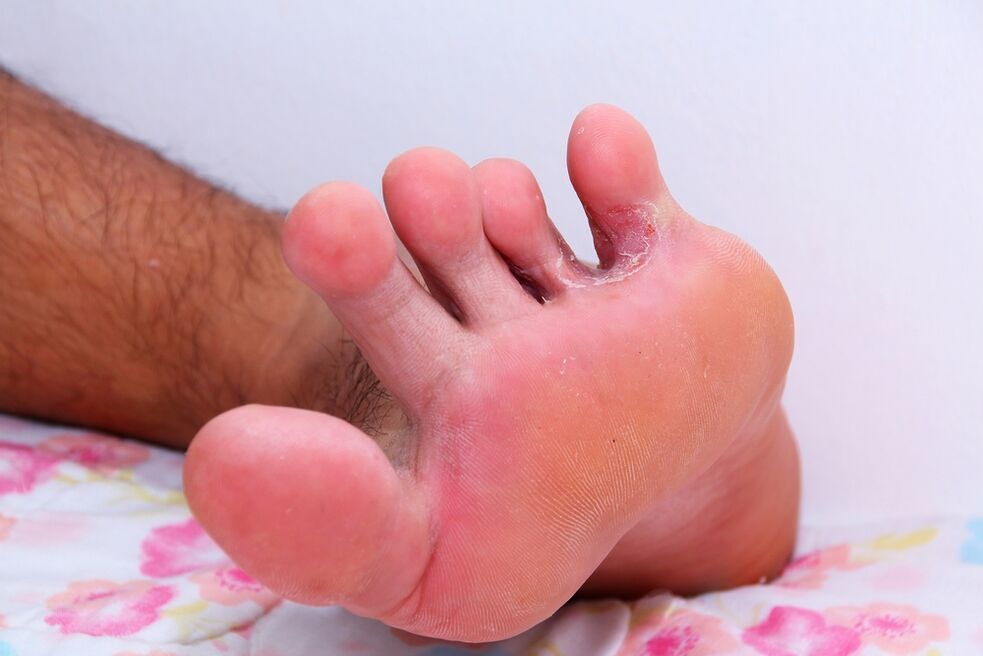
What does interdigital fungus look like?The signs of the disease are difficult to confuse with anything else, and an experienced doctor will only need one look at the patient to make a diagnosis.Typical symptoms make it possible to recognize the fungus at the initial stage of its appearance:
- cracks or wounds between the fingers;
- excessive peeling (yellow or whitish scales);
- areas of peeling skin between the fingers;
- itch;
- getting wet.
The symptoms of the disease can be very varied.In some people, the fungus between the toes appears as sores.
In some cases, ulcers and fissures may be covered by the typical whitish or yellowish scales.Peeling can be quite severe or slightly noticeable.
Often, areas of loose, dead skin appear between the toes.A typical sign of a fungal infection is itching, but its severity can vary greatly.
For some, itching becomes a very painful companion of the disease, while for others the fungus causes only mild discomfort.Skin with mycoses usually turns red, and there may be traces of scratches.
All these signs make it possible to accurately recognize foot fungus and distinguish it from other skin diseases.
A fungal infection between the toes is often associated with nail infections.A typical nail fungus looks like this:
- thickening of nails;
- change in nail color (from light pink to yellow, gray or brown);
- peeling of nails;
- fragility of the nail plate;
- itching and pain around the nails.
Special forms of fungus
In some cases, foot fungus leads to the appearance of not only cracks and ulcers.When a fungal infection develops, small blisters filled with clear or cloudy fluid may appear.
The skin swells and turns red.Over time, the bubbles burst and shallow depressions appear in their place.Ulcers hurt a lot and heal slowly.Scar formation is not typical.
This form of fungal infection is usually called vesicular-erosive.With the erased form of the disease, the skin does not change as much.In the chronic course of the disease, the skin peels off only in certain areas.
Peeling and roughness of the skin come first.Gradually, the skin becomes increasingly rough and acquires a characteristic yellowish color.Over time, the process can spread to the leg, thigh and buttocks.
Diagnosis
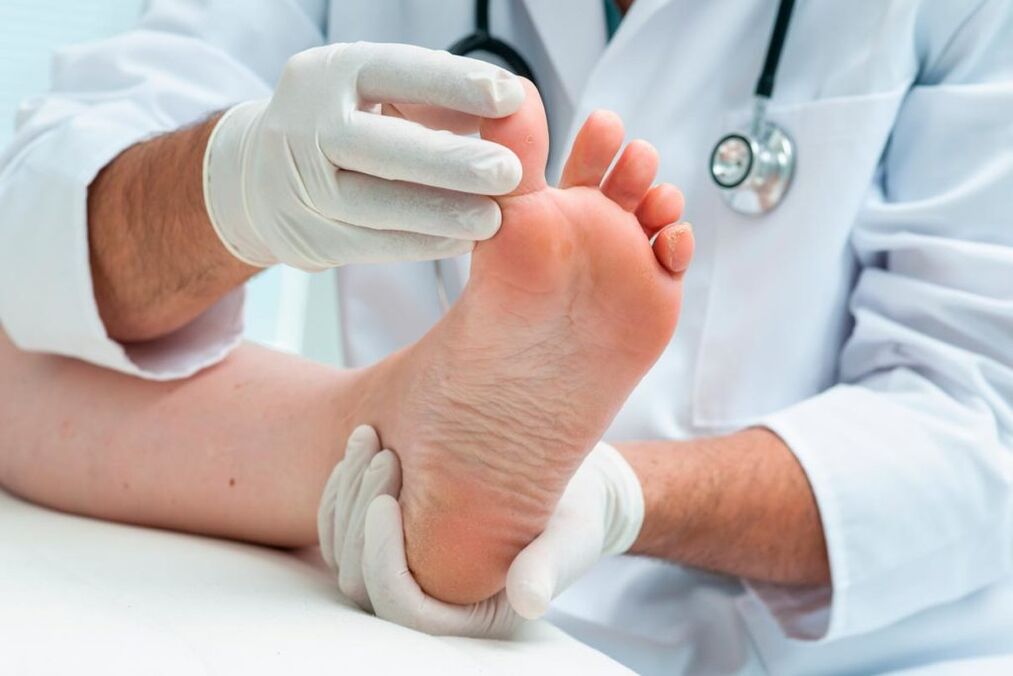
To recognize foot fungus, simply carefully examine the skin of the foot, the spaces between the toes and the nails.The typical signs of the disease leave no doubt as to the diagnosis.
To find out what type of fungus lives on the skin, it is necessary to scrape the affected areas and send the material to the laboratory.Bacteriological sowing of the material makes it possible to accurately determine the causative agent of the disease.
The test results will be ready within a few days, after which the doctor can begin treating the fungal infection.
Local therapy
Treatment of fungus between toes begins with the selection of antifungal medications.All means that can be used to treat an infection are divided into general and local medicines.
Local therapy is used in the early stages of the disease, when the fungal infection involves only the skin between the toes.In addition, topical preparations are widely used for combined nail injuries.
A wide selection of medicines allows you to choose the right medicine for almost any situation.A dermatologist should prescribe antimycotic medications.
Self-medication in this situation can lead to worsening of the condition, as the wrong medication can accelerate the progression of the disease.Furthermore, many antifungals have a large number of contraindications and can cause serious harm to health.
What remedies help against foot fungus?When interdigital folds are affected, it is best to use creams and ointments.It must be remembered that the skin in this area is quite thin.Careless actions can injure the space between the fingers and lead to the spread of infection.
The ointment or cream must be applied carefully, in a thin layer, on fissures and ulcers.When processing, you must cover not only the area affected by the fungus, but also the skin 2-3 cm around the spots.
This is necessary to destroy fungal elements on areas of still healthy skin.What is better to use for foot fungus: ointment or cream?The choice depends solely on the form of the disease.The ointment is recommended for application to dry, flaky skin.
It penetrates deeply into the affected area and effectively combats fungi that have become chronic.The ointment can also be applied under the bandage so that the medicine penetrates the deeper layers of the skin.
Fungal infections should be treated with cream in the phase of severe exacerbation of the disease.Itching, crying, ulcers and erosions are direct indications for applying the cream.The cream is quickly absorbed into the skin, leaving virtually no traces on clothes.
Preparations in cream form do not penetrate into the deep layers of the skin and are not used for severe roughness and peeling of the skin.Many medicines that eliminate foot fungus are available in two forms at once.
Dermatologists advise applying the ointment at night to enhance the effect of the product on dry and thickened areas of the skin.The cream can be used during the day to eliminate ulcers and watery eyes, as well as under clothing.
Unlike cream, ointment is absorbed much less easily and often leaves difficult-to-wash marks on clothes.What medications can be used to treat fungus between the toes?
The choice of remedy will depend on the pathogen identified.
Many medicines can treat not only fungi, but also bacterial infections, so they can be used for mixed skin lesions on the feet.
Systemic therapy
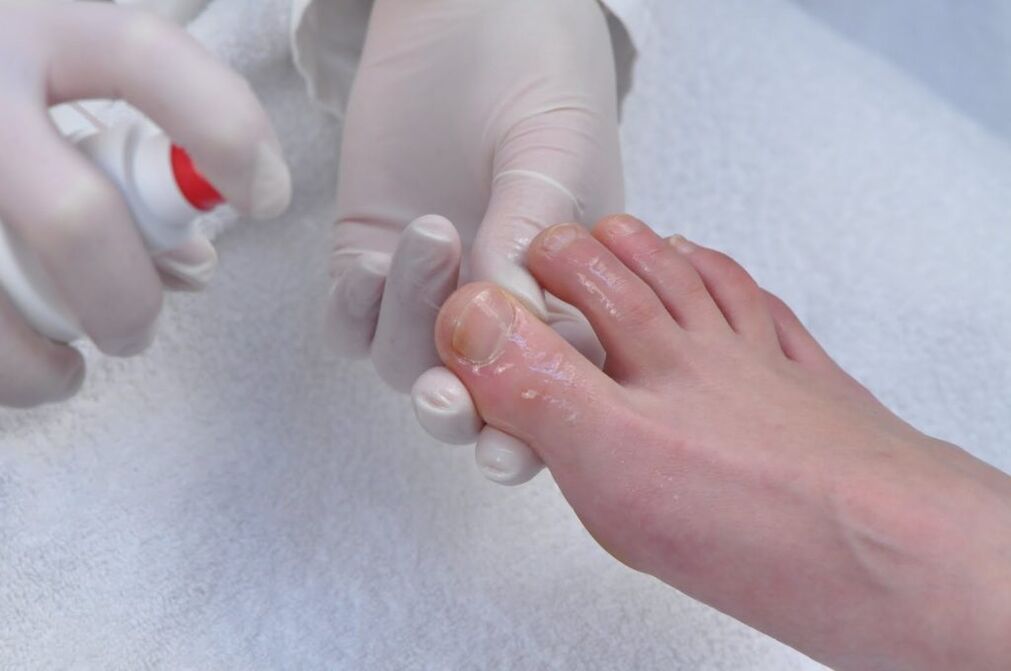
Treating foot fungus is not possible with local medicines alone.In some cases, doctors prescribe medications that affect the entire body.
Systemic therapy may be necessary if several interdigital spaces are affected at the same time, as well as if the process spreads to the nails and feet.
In their practice, dermatologists often use antifungal medications that effectively relieve itching and inflammation and help eliminate the main symptoms of a fungal infection.
- dysbiosis;
- dyspeptic disorders (nausea, vomiting, diarrhea);
- headaches;
- heart rhythm disturbances;
- liver and kidney damage;
- allergic reactions.
Prolonged treatment of foot fungus with systemic medications can cause serious malfunction of the entire body.
That is why it is so important that such remedies are prescribed only by a doctor after a complete examination.The duration of therapy and the dosage of drugs are selected taking into account the course of the infection and the presence of various concomitant pathologies in the patient.
An important point: treatment with systemic antifungals must be completed!Do not stop medication unless absolutely necessary.
Incomplete therapy may lead to the development of drug resistance.In the future, it will be very difficult to get rid of the mutant fungus and achieve recovery.
Folk remedies
Is it possible to treat foot fungus with folk remedies?It is believed that alternative therapy methods can actually relieve itching and eliminate other symptoms of fungal skin and nail infections.
Kombucha is considered a good remedy for ringworm.This plant was brought from Japan in the last century and has been very popular for many years.
A small piece of kombucha is rubbed into the spaces between the fingers twice a day for a month.If necessary, the treatment can be repeated after a two-week break.
Propolis and tea tree oil are also used to eliminate fungus.Treatment of foot fungus is also possible with the help of regular soda diluted in hot water (at the rate of 1 tablespoon of soda for every 3 liters of water).
The cooled solution is used to treat affected areas of the skin and nails twice a day.It should be remembered that treating fungus with folk remedies is possible only in the initial stages of the disease.In advanced cases, when the fungus affects the entire skin of the feet and nails, be sure to consult a doctor.
Ways to treat fungus with homemade products

- Garlic.
It is necessary to cut half a clove of garlic, roll it in salt and rub it into problem areas of the skin.Another option for using garlic is to grind the clove until it forms a pulp and make a compress on the affected areas or simply rub with the mixture.
- Onion.
Grind the onion into a paste and spread it over the painful spots on the surface of the skin.If there are sores or burst blisters on the skin, you can add petroleum jelly to the onion mixture (one to one ratio).Squeezed onion juice is also used to treat infections.You need to clean the infected areas of the skin with this liquid.
- Chicken egg.
To prepare the medicine, you need to pour vinegar over a whole raw egg and leave it in a dark place to infuse until the shell dissolves.Then you need to remove the film and add butter (1 teaspoon) to the resulting mixture of yolk, white and vinegar.
The resulting mass must be mixed well until it reaches the consistency of an ointment.Apply the ointment to clean, steamed feet, wrap with plastic wrap and gauze.The ointment must be stored in the refrigerator.
- Natural ground coffee.
This is another effective remedy in the fight against toe fungus.Before going to bed, it is recommended to take baths with strong ground coffee.These procedures will help eliminate unpleasant or painful sensations and heal irritations.
- Wine vinegar.
Apply wine vinegar to the affected areas and let it sit until the vinegar dries;no need to rinse with water.
- Apple cider vinegar.
In combination with sea salt, apple cider vinegar will help eliminate the irritating disease.To do this, you need to prepare a bath, which includes: 100 grams of sea salt, 4 spoons of vinegar and 5 liters of water.By repeating these baths every day, you can overcome the disease.
- Baking soda.
You need to soak the soda with water until a thin paste forms, which must be applied to the areas affected by the fungus for 20 minutes, then rinse your feet with warm water, wipe dry and apply baby powder.
Also, soda can be used in the form of cold baths.To do this, mix a tablespoon of soda and table salt and dilute everything in water.It is recommended to take these baths before going to sleep and then rinse the solution off with clean water.
Treating toe fungus with herbs

- Marigold flowers.
To prepare the infusion, place 250 g of dried flowers in a glass of boiling water and leave for half an hour.
- Celandine.
A decoction for foot baths is prepared from celandine;To do this, you need to prepare 4 tablespoons of the plant in 1 liter of water, boil for 5 minutes.These baths must be done for three weeks.
- Burdock leaves.
A fresh burdock leaf needs to be crushed so that the juice appears on the surface.Wrap the crumpled sheet around your foot and put on a sock overnight.The course of treatment is 3 weeks.
When the disease has already been defeated, personal hygiene items and shoes must be taken care of so that the infection does not spread again.You can treat the inside of your shoes with vinegar (30% solution) or antiseptic.
Therefore, despite the persistence and vitality of the fungus, there are many ways that will help get rid of it forever, you just need to have a little patience and not be too lazy to repeat daily procedures.
Fungal infection prevention
Treating fungus between your toes with traditional or folk remedies is a long and complex process.Is it possible to prevent the development of fungi?
The following recommendations will help prevent foot skin infections.Don't forget the rules of personal hygiene.Always wear flip flops in the pool, sauna or beach.Monitor the condition of the skin of the feet.
Moisturize your skin with special creams to prevent dryness and cracking.Strengthen your immune system and take care of your health.When the first signs of fungus appear between your toes, consult a doctor.